


Bill Jones (Yanchep Two Rocks RSL interim president with credit to AAP journalist Max Blenkin)
REMEMBRANCE Day is dedicated to all of those who have died as a direct result of war, from WW I onwards.
The day was originally called Armistice Day and observed each year at 11am on the 11th day of the 11th month to signify the official end of hostilities & the signing of the Armistice to end World War 1 in 1918.

On the first anniversary of the Armistice on November 11, 1919, the observance of one minute of silence was instituted as part of the main commemorative ceremony.
After the end of World War II in 1945, the British and Australian governments changed the name to Remembrance Day as being a more appropriate title for a day which would in future commemorate all war dead in all conflicts which sadly of course eventuated with several further wars.
The most enduring symbol of Remembrance Day is the red Flanders poppy.
 Yanchep Secondary College student captains Darcy Jackson and Phoebe Clune. Picture: Anita McInnes
The poppies were among the first flowering plants to spring to life in the battlefields of northern France and Belgium during The Great War.
A myth arose which had people believing that poppies were rich in their red colour because they blossomed from soil which had been saturated by the soldiers and war animals blood.
Remembrance Day in 2023, marked the 105th anniversary of that Armistice being signed in 1918.
It also marked the 106th anniversary of the worst year of the most hideous war in modern history.
As they shivered in trenches, dugouts and shell holes, enduring the harshest winter in decades for northern Europe, the Australian soldiers wondered if 1917 would be as bad as 1916.
After withdrawing from the Gallipoli campaign in late 1915, the diggers had arrived on the western Front in mid-1916 to find their introduction to ‘industrial warfare’ was going to be truly horrendous.
 Kai Gartrell and Juliette Barrow from the Two Rocks Youth in Emergency Cadets. Picture: Anita McInnes
In just the first eight weeks, the Australian Imperial Force experienced as many casualties as in eight months on Gallipoli, with 5500 dead and wounded at Fromelles and a further 23,000 at Pozieres.
With the onset of the bitter winter, the rain and incessant shellfire churned the ground into an impassable quagmire and the British commander-in-chief, General Douglas Haig finally conceded that enough was enough and called off the Somme offensive after 141 days.
Almost five months of relentless attacks had managed to push the German forces back a total distance of about 12km but they were far from defeated.
As it turned out, 1917 was indeed to be far worse than 1916 as the bloodletting reached new heights.
 Ted Maziuk from Yanchep Two Rocks RSL. Picture: Anita McInnes
The first major action on April 11 on the well defended town of Bullecourt, resulted in the diggers succeeding in penetrating the front line, but lacking artillery support and with the unreliability of the new but untested machines known as tanks, the result was carnage. Casualties exceeded 5000 and more than 1000 were taken prisoner, the single largest number of Australian prisoners in any action during WW I.
To this day, the remains of men and animals are still being discovered in the area, identified where possible and then removed for military burial in the various war cemeteries.
A second attempt in early May 1917 proved more successful, but even then, a fortnight of fighting produced another 7000 casualties.
 Jane Montgomery at the 2023 Remembrance Day Service at Yanchep National Park. Picture: Anita McInnes
Further south in mid-April, the French army launched the ‘Nivelle Offensive’, named after the General Robert Nivelle, who had loudly proclaimed he could achieve a decisive breakthrough.
He of course could not and failed, so for modest gains, overall casualties exceeded 100,000 resulting in driving the battered French Army to the brink of disintegration as exhausted troops began to mutiny.
At the same time, in Russia a succession of defeats with staggering losses
contributed to widespread national disaffection which fuelled the February Revolution, followed by the October Revolution which brought the Bolsheviks to power.
Russia then withdrew from the war, with big numbers of German troops therefore being freed up for operations on the Western Front against the allies.
During this period the USA had remained neutral, although it’s resolve was also being tested.
A German plot to recruit Mexico as an ally was uncovered by British intelligence.
The final straw was Germany’s resumption of unrestricted submarine warfare and the sinking of seven US ships.
The USA declared war on April 6, 1917 but it would be a year before big numbers of their combat troops actually reached Europe.
Meanwhile, Passchendaele became known as the byword for “vast casualties under appalling conditions”.
Various further mostly fruitless battles for tiny bits of landscape took place throughout the year.
For the soldiers, there was unparalleled misery as heavy rain and shellfire turned the low-lying battlefields into a vast area of swamp where heavily laden soldiers even drowned in the muddy shell holes.
The saturated ground meant that supply of ammunition, food and medical requirements, as well as simple communications, became a nightmare.
 Cornel Van Eden and Emma Brennan representing Two Rocks Volunteer Bushfire Brigade. Picture: Anita McInnes
Also, the artillery guns could not be brought forward to provide the massed barrages that had previously proven so effective.
Some of the wars most evocative images, photographs taken by Australians Frank Hurley and Hubert Wilkins depicted a totally shattered landscape of tree stumps, shell holes, mud, dead animals and constantly wet, diseased and exhausted soldiers.
With 38,000 dead and wounded the five divisions of the AIF were withdrawn from the line.
They were not to return to the front lines until March 1918.
For 1917 alone, Australian casualties totalled 76,836 dead and wounded.
The 40,000 dead from 1917 comprised two-thirds of all Australian dead in WW I and 40 per cent of all Australian war dead ever.
October 1917 was the worst single month, with 6400 killed.
 Phillip Dennis riding Indi and Suzanne Graham riding Tezza from the 10th Light Horse Memorial Troop. Picture: Anita McInnes
Now three years into what was a four-year war, the end seemed further away than ever, yet there were some bright spots.
In the area then known as Palestine the light horsemen had achieved good progress against Turkish forces culminating in the famous Australian mounted charge to seize the city of Beersheba on October 31.
In both France and Belgium the Australians had by now, well learned the business of industrial warfare.
The five AIF divisions, commanded by General Sir John Monash achieved a succession of victories in 1918 that contributed to the final allied victory, the signing of an Armistice and eventual return to peace.
WW I will always stand as Australia’s most costly in lives in the way of conventional warfare with the figures below showing why Remembrance Day is in solemn remembrance of all Australians who never returned from war.
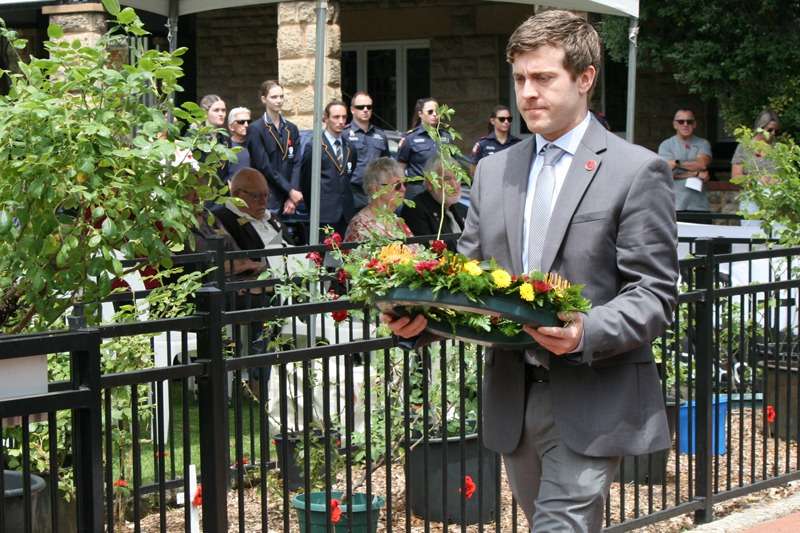 North ward councillor Alex Figg representing City of Wanneroo Mayor Linda Aitken. Picture: Anita McInnes
During the period of WW 1 Australia had a population of less than 5 million – 416,809 or nearly one-tenth of the population enlisted in the military forces.
More than 62,000 were killed and a further 156,000 wounded, gassed or taken as prisoners of war.
During WW II the total number killed was 27,073 with 23,477 wounded.
Korea resulted in 340 killed and 1216 wounded.
Vietnam concluded with 521 killed and 3000+ wounded.
About 165 Australians have been killed during the various conflicts and peacekeeping missions since Vietnam.
May each and every one of those brave dead rest in eternal peace having made the ultimate sacrifice in the service of their country.
 Sarah Baker of Yanchep and Jaxon Rhodes. Picture: Anita McInnes


